A single raised sidewalk slab can turn into an injury claim, a failed accessibility inspection or a resident complaint. For property managers, HOA boards and commercial owners, trip hazards are a risk-management problem as much as a repair problem. The good news is that most of them can be fixed quickly and for far less than replacing the walkway.
This guide explains what counts as a trip hazard, who is responsible for repairs in Denver, why delay raises your risk, and which repair options and costs to expect.
What Counts as a Sidewalk Trip Hazard?
A trip hazard is any spot where one slab sits higher than its neighbor, creating an edge someone can catch a foot on. Settlement, frost, tree roots and washed-out soil are the usual causes.
For accessible routes, the 2010 ADA Standards set clear limits on changes in level:
| Height of Change in Level | ADA Requirement |
|---|---|
| Up to 1/4 inch | Allowed as a vertical edge |
| Between 1/4 inch and 1/2 inch | Must be beveled with a slope no steeper than 1:2 |
| Over 1/2 inch | Must be ramped |
In practice, any offset of about 1/2 inch or more is widely treated as a serious trip hazard, and smaller edges can still catch a shoe or the wheel of a walker, stroller or wheelchair. If a walkway is part of an accessible route, these limits matter even for small offsets.
Who Is Responsible for Sidewalk Repair in Denver?
It depends on whose sidewalk it is.
Public sidewalks in Denver. Denver voters approved a citywide sidewalk program in 2022 that moved responsibility for repairing public sidewalks from adjacent property owners to the city. The program is funded by an annual fee charged to Denver property owners, and the city prioritizes repairs using reports from residents. Because repairs are scheduled citywide, a specific hazard may not be fixed right away.
Private walkways. Walkways inside your property, such as paths in HOA common areas, plazas, apartment and office campuses, and routes from parking to entrances, are generally not part of the city program. Owners and associations are typically responsible for keeping these in safe condition.
Other cities. Rules vary across the metro area, and in some cities adjacent owners are still responsible for the sidewalk in front of their property. Check your local ordinance.
This is general information, not legal advice. For questions about your specific obligations, talk to your attorney or insurance provider.
Why Trip Hazards Create Liability
Owners and managers are generally expected to keep walkways reasonably safe. If someone is injured on a defect you knew about, or should have known about, and the hazard was not repaired in a reasonable time, a premises liability claim becomes much easier to make. A raised slab that has been reported, photographed or complained about is hard to defend if it stays in place.
That is why fast, documented repairs protect you in two ways: they reduce the chance of an injury, and they show that you acted on the problem.
Common Causes of Trip Hazards in Denver
- Expansive clay soil that swells when wet and shrinks as it dries, leaving gaps under slabs
- Freeze-thaw cycles that heave and settle concrete each winter
- Tree roots that push slabs upward. See our page on heaved concrete.
- Poor drainage from downspouts, irrigation and grading that wash soil out from underneath
- Loose fill after construction or utility work that keeps settling
Trip Hazard Repair Options
| Option | Best For | Notes |
|---|---|---|
| Concrete lifting (leveling) | Slabs that have settled but are still sound | Raises the slab back to level by filling the void underneath |
| Grinding or shaving | Small offsets, such as a lip of about an inch or less | Removes the edge but does not fix the settlement underneath |
| Crack and joint repair | Cracks and gaps that let water under the slab | Helps prevent further movement |
| Slab replacement | Crumbling, shattered or structurally failed slabs | Highest cost and the most disruption |
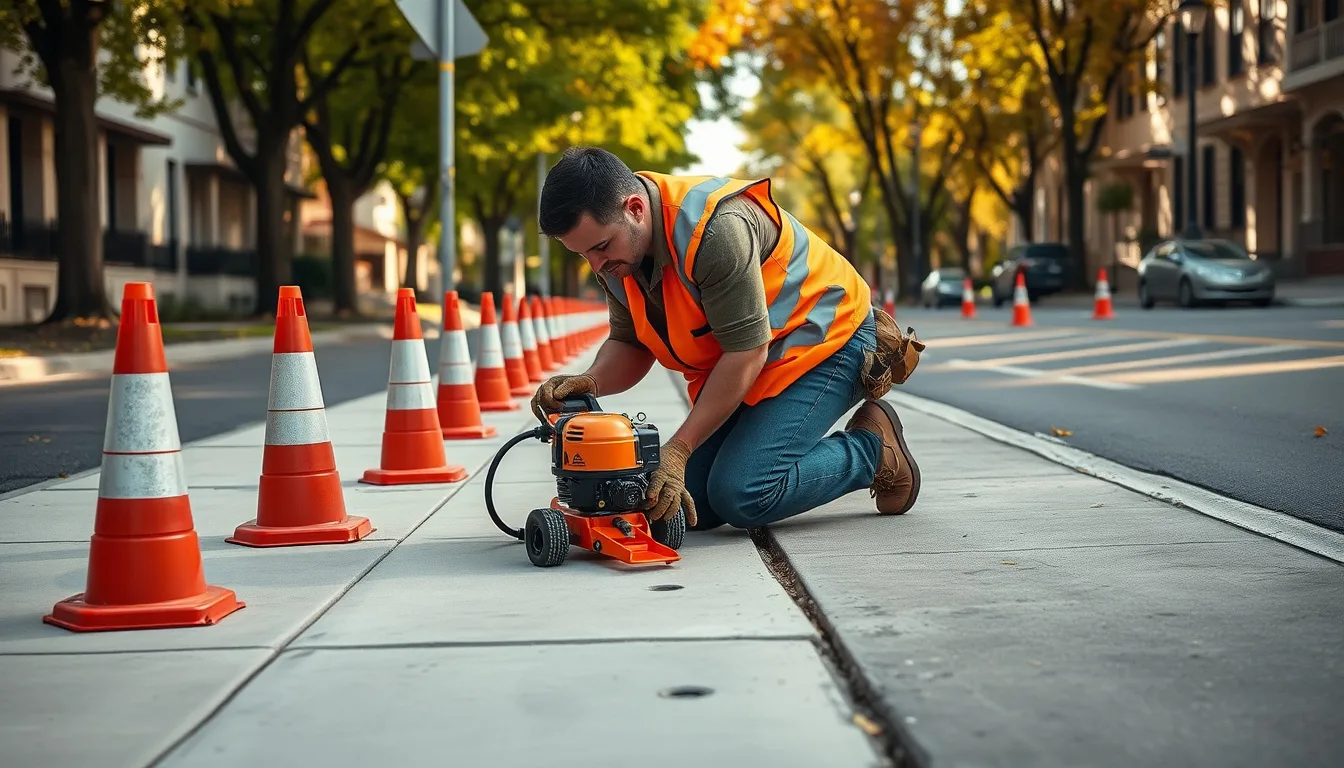
Concrete lifting is usually the best fit for managed properties because it fixes the cause of the offset, the missing support, rather than just shaving the edge. See our sidewalk leveling service and our wider concrete leveling services. Cracked slabs may also need crack repair, and slabs that are broken beyond saving may need to be removed and replaced.
Commercial Concrete Leveling: Why It Suits Property Managers
For HOAs, apartment communities and commercial sites, lifting has practical advantages over replacement:
- Less disruption. There is no demolition and no weeks of curing, so walkways return to use quickly.
- Phased work. Repairs can be scheduled in sections so entrances and main routes stay open.
- Lower cost. Lifting typically costs far less than tearing out and repouring.
- Faster response. You can clear priority hazards first and handle the rest on a plan.
How Much Does Sidewalk Trip Hazard Repair Cost?
Published national cost guides put mudjacking at roughly $3 to $8 per square foot and polyurethane foam at roughly $5 to $25 per square foot, depending on lift depth and materials. Replacement generally costs more once you add demolition, disposal and a new pour.
For property managers, the total depends on scope more than any single rate:
- The number of slabs and how far each has dropped
- Access to the walkways and whether work must happen around foot traffic
- Whether voids, drainage or tree roots need to be addressed
- Minimum charges on small jobs, which can raise the per-square-foot price
The most reliable way to budget is a walk-through of the property, ideally with an itemized estimate by location so you can prioritize the worst hazards first.
A Practical Trip Hazard Checklist for Property Managers
- Inspect on a schedule. Walk all routes at least once or twice a year, and after winter thaws and heavy storms.
- Measure and photograph. Record the height of each offset with a date, a location and a photo.
- Keep a log. Track every hazard found, every resident report and every repair.
- Prioritize. Start with the largest offsets, the busiest routes and any accessible routes.
- Get quotes. Ask for itemized pricing by slab or location.
- Repair and document. Keep invoices and after-repair photos on file.
- Fix the cause. Address drainage and soil issues so the repair holds.
Frequently Asked Questions
What height is a sidewalk trip hazard? There is no single universal number, but offsets of about 1/2 inch or more are widely treated as serious. The ADA allows a vertical change of up to 1/4 inch on accessible routes, requires a bevel between 1/4 and 1/2 inch, and requires a ramp above 1/2 inch.
Who repairs sidewalks in Denver? For public sidewalks, the city runs a citywide program funded by a fee on property owners. Private walkways on HOA, commercial and apartment property are generally the owner’s or association’s responsibility.
Is an HOA responsible for sidewalk repair? For walkways in common areas, usually yes. Check your governing documents and the local ordinance for public sidewalks along your property.
Can concrete leveling fix an ADA sidewalk problem? Often, yes. Raising a settled slab back level can bring an offset within the allowed range. Complex accessible-route issues may need a design review, so confirm requirements for your property.
How long does a sidewalk repair take? Most lifting projects are completed in a single visit, and many walkways can be used again within a day or less, depending on the method.
Get a Trip Hazard Assessment in Denver
If you manage an HOA, apartment community or commercial property, a quick walk-through will show which slabs can be lifted, which need other repairs and what it will cost. Repair My Concrete serves Denver and the surrounding Colorado area with concrete lifting, leveling and repair. Request a free estimate and we will inspect your walkways and give you a clear plan.
